Marketplace and classified ad scams in Switzerland: recognising and responding
A bike, a phone, a flat, a concert ticket: fraud between private individuals requires neither technical skill nor much investment. It repeats because it works, and because victims rarely file a complaint over a few hundred francs.
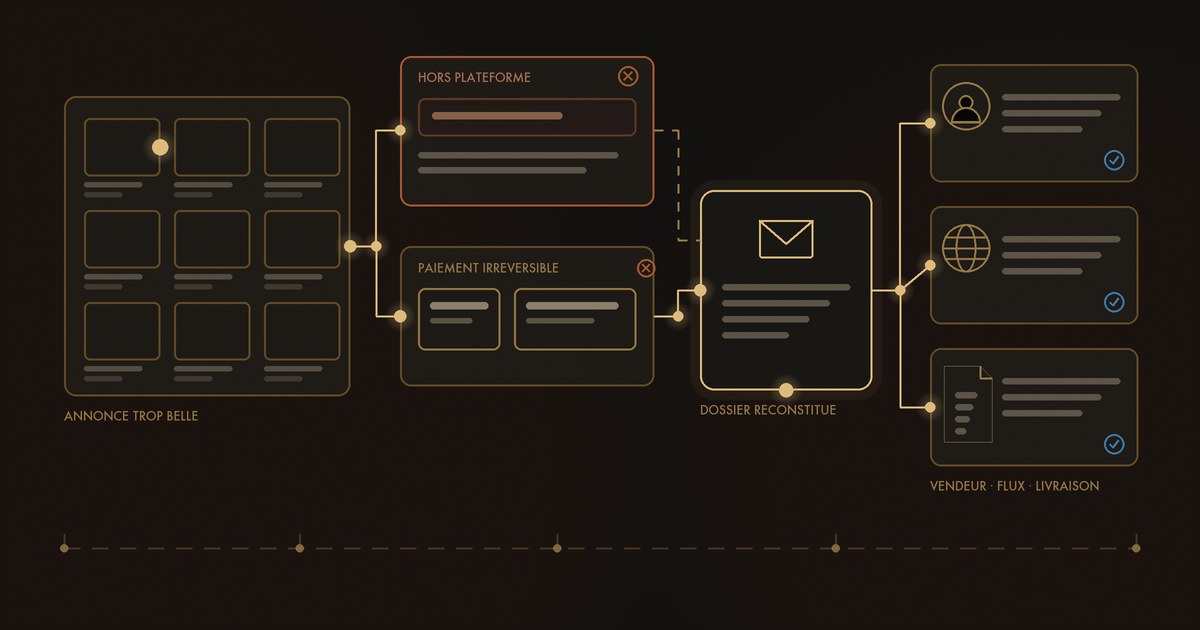
Swiss classified sites and social media marketplaces concentrate a significant share of reported fraud, because they bring together three favourable conditions: strangers, fast payments, and pressure to close before "the other buyer". The setups vary in their dressing but all rest on the same mechanism, which is what makes them recognisable in time.
Two families of setups, one mechanism
Whether you are buying or selling, the sequence is identical: fast, courteous contact, a reason to leave the platform, then a payment method chosen for its irreversibility. Understanding these two steps is worth more than memorising a list of pretexts, because the pretexts change every season while the mechanism stays stable.
On the buyer side: paying for an item that does not exist
The listing shows a price well below market and attractive photographs, often taken from another site. The seller is "travelling", offers shipping via a carrier of his choosing, and asks for a deposit to "reserve" the item. After the payment, the item does not arrive; instead come additional fees: customs, insurance, parcel release. Each payment calls for another, and the listing disappears.
A more polished variant relies on a fake delivery-tracking site whose link is sent during the conversation. The page imitates a known carrier and serves either to demand fees or to capture card details. The useful check is simple: the creation date of the domain name, as explained in our OSINT guide.
On the seller side: the fake payment and the trap link
Here the fraudster poses as a buyer in a hurry, accepts the price without negotiating and offers to pay immediately. He then sends a link supposedly confirming the payment, or a screenshot of it. The link leads to a page imitating a payment service or a messaging app, with a single purpose: to obtain your credentials, or to have you approve what is in fact a debit from your account.
A second classic setup is the overpayment: the buyer claims to have paid too much, produces a falsified receipt, and asks for the difference to be refunded. The initial payment never took place, or will be reversed; only your refund is real.
The six signals that should stop the transaction
- A price too low for a sought-after item, paired with a reason to sell quickly.
- Leaving the platform proposed in the very first messages.
- No possibility of seeing the item or meeting the person, always justified by travel.
- A carrier imposed by the other party, with an unfamiliar tracking site.
- A payment or confirmation link sent by the person themselves.
- Successive fees demanded after the first payment, whatever the stated reason.
What to do once the money has gone
- Stop any further payment, including fees presented as the condition for release.
- Contact your bank or payment service and ask for the operation to be blocked and recalled, giving the exact time and reference.
- Report the listing and the account to the platform, which triggers suspension and data preservation.
- Capture the listing before it disappears: profile, complete conversation, exact URL, published photographs.
- File a complaint with the cantonal police, with the chronology, the receipts and the beneficiary's details.
- Report the fraudulent page to antiphishing.ch and the Federal Office for Cybersecurity if a fake site was involved.
The procedure is detailed in our guide on filing a complaint in Switzerland.
The traces that make the case workable
Fraudulent listings are deleted within hours, and that is the main reason these cases stall for lack of material. What must be preserved immediately:
- The exact URL of the listing and its identifier on the platform.
- The seller's profile link, its age and any ratings.
- The entire conversation, uncut, with visible timestamps.
- The payment details: IBAN, beneficiary name, phone number, wallet address.
- The listing photographs, useful in reverse image search to find the same setup elsewhere.
- The bank records and your exchanges with the bank and the platform.
These elements often make it possible to link one listing to a series: same photographs, same IBAN, same fake-site template. The vocabulary used here is defined in our glossary.
Have your case reconstructed
We cross-reference listings, digital identities and cash-out details to connect your case to a wider setup, and produce a dated file you can use for your complaint. Feasibility review before any engagement.
Open my investigation file
Frequently asked questions
Why does the buyer want to leave the platform?
Because the platform keeps the traces, enforces its rules and can suspend the account. By moving the exchange to a private messaging app or to email, the fraudster removes the contractual protection, the automatic warnings and the searchable history. Insisting on leaving the platform in the first few messages is in itself a warning signal.
Is the payment link I was sent reliable?
A legitimate seller or buyer does not need to send you a link in order to pay you money. Links passed on in this context generally lead to a page imitating a payment service or a messaging app, and exist to capture your credentials or to make you approve a debit. Always check the operation from your own application, never from a link you received.
Can I recover a payment sent to a private individual?
It depends on the method used and on how quickly you react. A bank transfer can be subject to a recall request as long as the funds have not been withdrawn. Instant peer-to-peer payments, prepaid cards and cryptocurrencies are designed to be hard to reverse. In every case, contact your bank without delay and request the recall in writing.
Is the platform responsible for the scam?
Classified sites present themselves as intermediaries rather than parties to the contract, which strongly limits their liability for a transaction concluded between private individuals. They do have a useful role: suspending the account, preserving data and responding to requests from the authorities. This is why reporting to the platform should accompany the criminal complaint, not replace it.
Official sources
This article is informational and does not constitute individual legal advice. For any decision, consult a qualified professional with regard to your situation.